
The collision repair sector is one of the most dynamic and rapidly evolving sectors in the automotive landscape. Far removed from the outdated perceptions that hound many automotive industry sectors, today’s collision repairers operate in a high-tech environment shaped by advanced materials, ADAS-equipped vehicles and increasingly complex repair processes. It is an industry built on precision and innovation, and one which teems with skilled tradespeople, entrepreneurial owners and passionate apprentices.
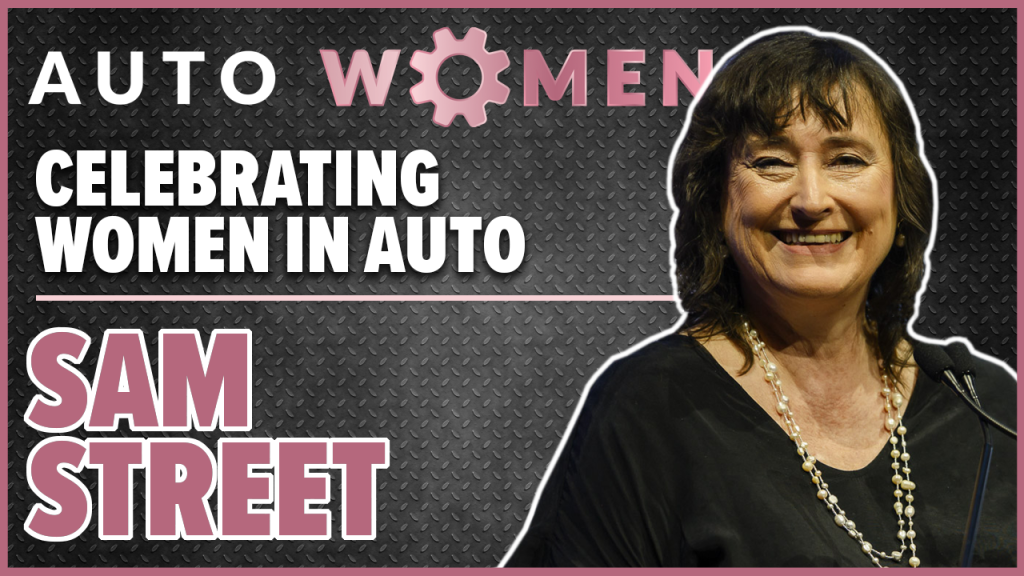
For the past 15 years, Sam Street has been beating the drum for the collision repair sector, promoting it and shining a light on the people who work within it through her role as editor of Yaffa Media’s Australasian Paint & Panel magazine.
During those years, Sam has gone beyond simply reporting on the sector, becoming its passionate advocate. And through her work, the often-overlooked world of collision repair has been given quite a voice, with the stories and achievements of its workforce finding their way onto the pages of the magazine, the Paint & Panel website, other channels and platforms, and through the establishment of industry awards events and even a new advocacy organisation – the Australian Collision Industry Alliance (ACIA).
In doing all this, Sam has established herself as one of the sector’s most influential and respected figures.
A CLASSICAL BEGINNING
Sam’s career journey was anything but planned and she certainly did not set out with dreams of becoming editor of an Australian magazine that focused on the collision repair sector – that would be a strange goal indeed for a young Englishwoman who had been to university to study Classical Civilisation and the wonders of ancient Greece and Rome.
Emerging from the world of education in the late 1980s, Sam’s first goal was to work in television, a goal that necessitated learning the ropes of being a reporter.
“In order to be a TV presenter back then you had to be a journalist,” she says.
However, breaking into journalism proved tricky and she took a punt on writing to a classic car magazine that was advertising for an editor and asking for any available role.
“I said, I know I can’t be editor but could I be something else?” she says.
It was something of a cheeky move as, at the time, Sam didn’t even have a driving licence. However, her initiative nonetheless landed her a job at Auto Classic.
“I was employed as a lowly editorial assistant,” explains Sam. “I was about 23 and I lived in London so there was really good public transport and I didn’t really need to drive a car. But the office was far away, so I got my driving license and, after a while, became completely hooked on classic cars. Because how can you not?”
It was the role through which she would spark her fascination with cars and which would be the starting point for her automotive journalism journey.
Although the decision to commit to that path was still some way off, writing about cars was an area of work that kept drawing her in and when Auto Classic closed down, Sam went freelance, doing work for, amongst others, publications aimed at young women and writing automotive-flavoured articles with titles such as ‘Does your motor rev his engine?’
This early freelance work did lead to some interesting jobs, including one in which 19 magazine – a very popular publication of the time – sent Sam to Rome for the launch of a new moped. It was jobs like this that made Sam think that, maybe, automotive journalism might be for her.
Over the next few years she worked for a number of publications in a variety of roles – from writer and reporter to subeditor and then editor – until she landed a monster gig at Ford magazine, a title published by Ford’s UK arm which boasted a colossal circulation figure and, thanks to the financial muscle of its parent, equally muscular funding.
“. . . Ford magazine went out to 800,000 people and had a budget bigger than Ben-Hur,” says Sam with a chuckle. “We had models for the front cover and it was crazy!”
It was while working at Ford magazine that an opportunity arose that might have completely changed the course of Sam’s career – an opportunity that could, perhaps, have enabled her to fulfil her early dream of working in television. But more on that later.
A NEW CHAPTER DOWN UNDER
By 2005, Sam was married, had a young son and, professionally and personally, things looked rather great. So it was the perfect time to pull up stumps and move to the other side of the world!
“At the time I moved over to Australia my son was three-and-a-half years old and my husband, who is Australian, wanted to bring his son up in God’s country,” says Sam. “I decided I would give it a go but we didn’t sell our house. I said, ‘I’ll give it five years’.”
The move to Australia gave Sam the chance to reassess her career and try her hand at something other than automotive journalism. She soon saw the chance to work on a product that offered just that opportunity.
“I spotted Yaffa Media and decided that, after many years of working in motoring, I was going to do something completely different,” she says. “It was a new chapter in my life and so I applied for possibly the most boring publication on the planet which was called Stationery News. It was about pens and paper, and I probably would have lasted a month!” she says. “They [Yaffa Media] said, ‘Oh no, you don’t want to do that, you want to do Paint and Panel magazine, but I said no, I really don’t want to do it. In the end I said I’d do it for a year and here I am 15 years later, loving it!”
Encouraging Sam to take on Paint & Panel turned out to be an inspired piece of work from the bosses at Yaffa Media. In the years since taking on the editor’s role she has helped to shepherd the title to become much more than an essential read for those in the collision repair industry. The connections and relationships she has nurtured have led to the growth of existing events and the development of new ones that not only support and promote the industry, but recognise its skilled, hard-grafting and entrepreneurial workforce.
Chief amongst these is the Bodyshop Awards – an awards event that will celebrate its 30th edition in 2026.
Celebrating the industry and the ‘innovative bodyshop owners and managers and their outstanding achievements’, the Bodyshop Awards recognises outstanding businesses and individuals across a range of classifications in three categories – Best Shop Awards, Best Practice Awards, and Individual Awards.
When Sam arrived at Paint & Panel magazine, the awards were a modest affair. Today, it is a true, national event and one with which she is proud to have been involved and help grow.
“The awards are the industry’s night of nights and people come from all over the country,” says Sam. “. . . It’s just fun, and it’s wonderful for all these different people.
“The majority of them, the collision repair owners, get to dress up and really enjoy their success and their achievements.”
They deserve the recognition, she adds.
“. . . What they do is really important for society, particularly in Australia where we’re so dependent on the car as a mode of transport. If you’re involved in automotive and keeping people on the road, I think that that’s something to be really proud of.”
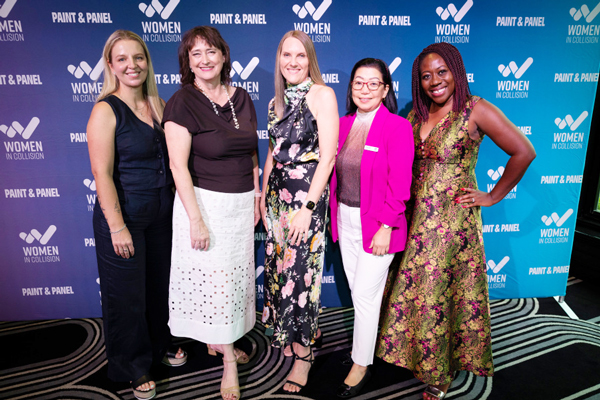
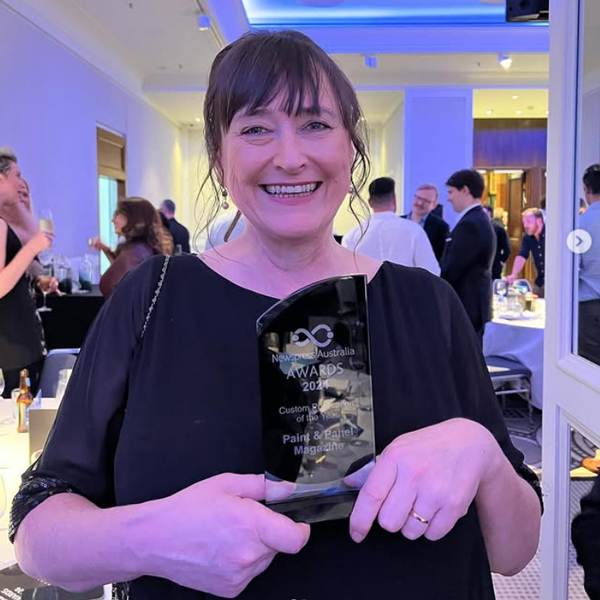
The Bodyshop Awards have been joined in recent years by the Women in Collision awards which recognise the contributions of women across a wide range of roles – from technicians and apprentices, to managers, business owners and supplier representatives.
Establishing those awards was a way to recognise that women were often playing vital roles in the running and success of businesses.
“We realised very early on that women were often the driving force behind the business,” says Sam with a smile. “While the men peacock around the workshop, the women were actually doing the things that kept the business going – HR, payroll, OH&S – important stuff which isn’t quite as glamorous as wielding a welder or a spray gun.”
With 56 finalists across eight categories, the latest edition of the Women in Collision awards – held in February at a swanky event in Sydney – was the biggest yet and it is now one of Australia’s leading platforms for recognising women in collision repair.
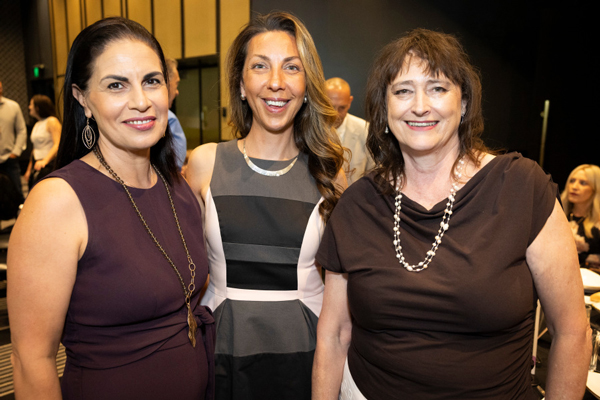
The awards are a reflection of both the cultural change and workforce needs within the industry, two factors that were also instrumental in the decision to launch the Auto Women initiative – an initiative that Sam enthusiastically backs as it offers access to support and networking opportunities that are vital for success.
“Networking is one of the most valuable things you can do whatever you do in life,” she says. “What you know is important, but who you know is important too . . . And the other thing is knowing that you’ve got a mentor or somebody who you can call if you’re feeling uncomfortable about something or you’ve got a difficult decision to make about where you go next. It’s always good to talk these things over with somebody who’s opinion you respect . . . I think it’s a really great initiative.”
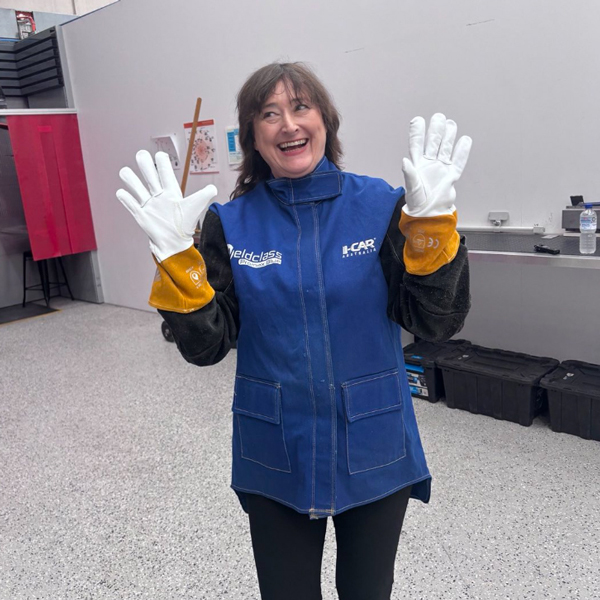
DRIVING THE INDUSTRY FORWARD
15 years ago, Sam took on the editorship of Australasian Paint & Panel as a job, but it has become much more. Working with, and writing about and promoting, the collision repair sector has seen her develop a genuine passion for the industry. So much so, in fact, that it has led to her being deeply involved with launching another initiative – the Australian Collision Industry Alliance (ACIA).
Established in 2023, the ACIA is a not-for-profit organisation, the core purpose of which is to promote the collision repair industry as a viable career path and to ensure its long-term sustainability. As with many sectors in the automotive industry, collision repair is facing skills shortages and an aging workforce, and the ACIA works by coordinating stakeholders – repairers, insurers, OEMs, suppliers, dealer groups, training providers and industry associations – to deliver programs designed to attract and retain new talent.
So, for those searching for a potential career in automotive, Sam is keen to highlight the opportunities available in collision repair.
“It is an industry that is very hungry for young people in particular, but basically people with pulses are a very good thing!” she says with a laugh. “I’m not saying they would just take anyone, but I think there are so many opportunities . . . you can start off in customer service and end up as an estimator or a painter or a manager or even you own your own business.
“If you’re interested in a career, then it will be very easy for you to find work experience to just give it a try. There are lots of people who are willing to host you, so come on in!”
THE ONE THAT GOT AWAY
‘Give it a try’ and ‘Having a go’ is good advice for those pondering whether or not to give collision repair – or any of the other automotive industry sectors – a go as a potential career. If your interest lies in that direction and the opportunity is there, why not give it a crack?
It’s a slice of advice that Sam espouses today and it’s advice she would like to give her younger self if she were able to travel back in time.
You may recall that her original plan was to work in television. It was the very reason she became a journalist and Sam concedes that she was presented with an opportunity to dip her toe into that world and, perhaps, forge a very different career, one that might have reached Top Gear, so to speak.
“When I was editor of Ford magazine, I was asked if I would go on a daytime program and do a slot on what people kept in their cars and what that said about them,” she explains. “I said I would do it but as it got nearer to the time, I wasn’t feeling 100% and I was really nervous, and so I said I wouldn’t do it.”
The now empty TV show slot had to be taken by someone, so in stepped another motoring journalist.
“I’ll just tell you who did get that slot – James May! And if you’ve seen Top Gear, you’ll know who that is!
“That could have been the making of my TV career!” she says with a wry smile. “However, I’ve been very happy and fulfilled in what I do, so I’m not going to complain. But I would tell my younger self to grow a backbone!”
A JENSEN IS ON THE BUTTON
Despite a career writing about the automotive industry and being passionate about cars, Sam is pretty practical about transportation. There is no classic or rare car in her garage – yet.
“I have a 2007 Astra that my husband bought for five grand at the beginning of COVID, before the second-hand car prices went up, and it gets me from A to B,” she says with a chuckle. “When I retire, I’m going to buy myself a nice car but, for now, the little Astra is doing me proud.”
But what will that ‘nice’, retirement car be? If money were no object, what would Sam choose to own?
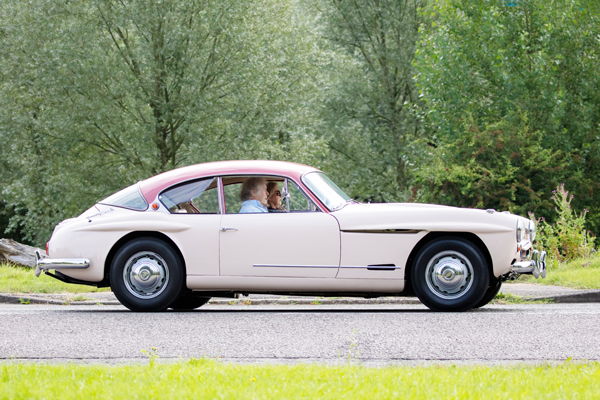
Not surprisingly, the choice – a Jensen 541R – is a stunner. A cracker of a British grand tourer from the late 1950s that offered luxury and genuine performance, it’s a choice that reflects Sam’s love of cars and a reminder that she once worked for Auto Classic magazine.
“I think it is the most beautiful car . . . and it just makes me go weak at the knees,” she says. “It would actually make me clear out my garage so I could park it there and if you knew how much I hate clearing up, that’s how much I’d like one of those!”
AN UNEXPECTED JOURNEY
Sam Street didn’t plan to become a central figure in Australia’s collision repair sector. However, she has become precisely that and is helping to shape and promote it, celebrate the achievements of those in it, and work towards ensuring its future is bright.
It’s an unlikely journey for the Classical Civilisation student from the UK who wanted to work in television, but one that has made a lasting impact on the industry.