
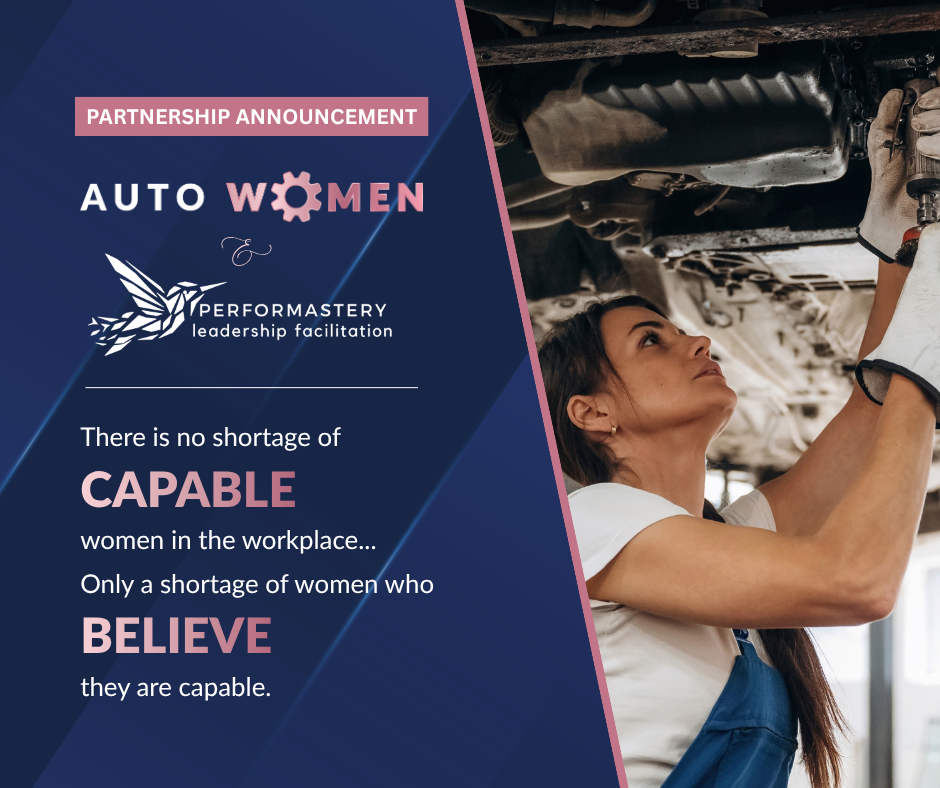
There is no shortage of capable women in the workplace. There is a shortage of women who BELIEVE they are capable.
This is a statement I feel very strongly about, and it’s the idea at the heart of a new partnership between Performastery Leadership Facilitation and Auto Women, focused on supporting more women across the automotive industry to recognise their leadership capability, develop it and back themselves to step forward.
But before I tell you more about the partnership, I want to explore why I believe this matters.
When being capable isn’t enough
Throughout my career, I’ve worked with some incredibly capable people. People who are respected by their colleagues, trusted by their managers and relied upon when something needs sorting out. They take responsibility, solve problems, support the people around them and get things done.
Yet, when the conversation turns to leadership, something interesting often happens. Instead of recognising all the evidence of what they already bring, they start focusing on what they don’t know. Their internal conversation sounds something like, “I don’t have enough experience yet” or “I’m not sure I know enough” or “Maybe I need another qualification before I put my hand up.” And suddenly, the very person everyone else sees as capable starts questioning whether they’re ready.
Here’s the thing… being capable and believing you’re capable are two very different things.
You can have years of experience, sound judgement and a track record of delivering results, but if you don’t recognise those things as evidence of your leadership capability, you may never give yourself permission to take that next step. And that’s a real loss. Not just for the individual, but for the business and the people who could benefit from their leadership.
The leadership capability you might not recognise in yourself
One of the things I’ve noticed over many years of facilitating leadership development is that people often have a much narrower definition of leadership than they realise. They associate leadership with a title, a position of authority or being the person who has all the answers. So when I ask someone whether they see themselves as a leader, their response might be, “Not really. I’m just doing my job.”
But let’s look at what that job actually involves.
Perhaps you’re the person colleagues turn to when they need advice. You’re the one who notices when something isn’t working and takes the initiative to fix it. You help new team members find their feet, you keep things moving when the pressure is on, and you take responsibility for making sure things get done.
Those are all behaviours that can contribute to effective leadership.
Of course, being good at your job doesn’t automatically mean you know how to lead people. That’s a whole different skill set, and one that needs to be learned and practised. But there’s a big difference between recognising that you have leadership skills to develop or believing you’re not capable of becoming a leader in the first place. One gives you somewhere to start. The other can stop you from starting at all.
Why this matters in traditionally male-dominated industries
For women working in industries such as automotive, plumbing, electrical, construction, manufacturing, engineering and other trades, the challenge can be even more complicated. When you’re working in an environment where most of the people in senior positions don’t necessarily look like you, it can be harder to picture yourself in those roles.
Furthermore, you may feel you need to prove yourself more, know more or be more experienced before you’re willing to put your hand up. When you do start considering leadership, there’s sometimes an unspoken assumption that you need to become more assertive, tougher or louder to be taken seriously.
I don’t believe that’s the answer. Leadership isn’t about becoming someone else.
It’s about understanding who you are, recognising the strengths and capabilities you already bring, identifying the skills you still need to develop and learning how to use all of that to bring out the best in others. That’s what I mean when I talk about unleashing your leader within.
Not creating a completely different version of yourself, but developing the leadership capability that’s already beginning to show up in the way you think, behave and interact with others.
Sometimes someone else sees your potential before you do
There’s another side to this conversation that I think is equally important. The role employers play in recognising and developing the leadership potential of the women already working in their businesses. Think about the people you rely on most. Who takes responsibility without constantly being asked? Who demonstrates sound judgement? Who do others naturally turn to for guidance? Who takes the time to support less experienced colleagues?
Now ask yourself: have you ever had a conversation with those people about their leadership potential?
More often than not, the difference between a capable employee staying exactly where they are and becoming an effective leader is having someone say, “I can see something in you, and I’d like to help you develop it.”
Of course, recognising potential is only the beginning. Promoting someone because they’re technically capable, without giving them the skills to lead people, can create a whole new set of challenges. They suddenly find themselves responsible for setting expectations, giving feedback, managing performance, delegating work and having difficult conversations often without ever being taught how to do those things.
That’s why I believe leadership development needs to address both sides of the equation. Helping people believe in their capability AND giving them the practical skills to lead effectively.
Turning belief into leadership impact
This is where the real work begins. Recognising your potential is important, but belief alone isn’t enough. You also need to learn how to translate that belief into the way you show up and lead others.
For an emerging leader, that might mean learning how to delegate rather than feeling responsible for doing everything yourself. It might mean finding the confidence to have a difficult conversation rather than avoiding it, or learning how to set clear expectations and hold people accountable.
For a more experienced leader, it might mean stepping back from day-to-day operations, broadening your perspective, influencing decisions beyond your immediate team or preparing yourself for greater organisational responsibility.
The skills may be different, but the underlying development journey is similar.
First, you begin to see yourself and your capability differently. That changes how you show up, the decisions you make and the opportunities you’re willing to pursue. Then over time, it changes the impact you have on the people and business around you. Insight leads to Identity which leads to Impact. That’s the kind of leadership development I’m passionate about.
Introducing the Auto Women × Performastery partnership
It’s also why I feel incredibly grateful and genuinely honoured to be partnering with Auto Women and the broader automotive industry. Together, we’re creating more opportunities for women to recognise their leadership capability, develop it and back themselves to step forward.
At the centre of the partnership are two Leaders Unleashed programs designed for women at different stages of their leadership journey.
SPRINT HURDLES: For Emerging & Developing Leaders
For women preparing to step into leadership, recently promoted into a team leader, supervisor or management role, or already demonstrating leadership capability without necessarily holding the title. SPRINT HURDLES helps women make one of the most important shifts in their career to go from being great at what they do to learning how to bring out the best in others.
ASCENSION: For Experienced & Senior Leaders
For established women leaders who are ready to broaden their perspective, increase their influence and strengthen the strategic leadership capability required to take on greater organisational responsibility.
Both programs bring women together from across male-dominated industries, creating opportunities to learn alongside others with different experiences, perspectives and workplace challenges, while building relationships and professional networks beyond their own organisations.
Employers can invest directly in one or more women from their business, while individuals can also nominate themselves and choose to self-fund or seek employer support.
As part of the partnership, Auto Women will also offer two scholarship positions per intake – one in SPRINT HURDLES and one in ASCENSION.
So, who’s ready to take the next step?
If you’re a woman reading this and recognising some of those internal conversations, perhaps it’s worth asking yourself a different question. Instead of “What don’t I know yet?”, what if you asked, “What evidence do I already have that I’m capable of more?”
If you’re an employer, perhaps there’s someone in your business who immediately comes to mind. Someone who is already demonstrating the behaviours of a potential leader, but who may not yet recognise that capability in herself. What might change if you helped her see it?
REMEMBER: There really is no shortage of capable women in our workplaces. The opportunity is to help more of them BELIEVE in their capability, develop the skills to back it up and step forward to lead.
Register your interest for Leaders Unleashed 2027
Whether you’re looking to invest in your own leadership development or you’re an employer wanting to develop the women within your business – Register your interest for the 2027 intake
For information about the Auto Women Scholarships, including eligibility and applications, visit Auto Women Scholarships. The current scholarship round is now open!
Fiona Cullen is the founder of Performastery Leadership Facilitation and facilitator of the Leaders Unleashed leadership development programs.
ABOUT THE CONTRIBUTOR
Performastery Leadership Facilitation
Performastery helps emerging leaders confidently cultivate their leadership mastery and unleash their high-impact leader within. Drawing on more than 25 years of experience across the commercial, not-for-profit and public sectors.